

The Mind’s Control Panel: Why Your Brain Won’t Stop Twiddling the Dials

The odds are you’re running an entire control room inside your head — complete with buttons, sliders and dials. And probably dodgy wiring, and the occasional “Why did I press that?” moment.
Most people never discover it.
You’re about to.
Welcome to the Mind’s Control Panel
Here you find the invisible settings that change how you feel, think, react, and occasionally terrify yourself for no sensible reason.
The best part is, you’re already using it.
You’ve just never been shown how to operate the thing intentionally.
What on earth are ‘submodalities’?
If “submodalities” sounds like a word only an NLP practitioner could love — you’re right — but don’t panic.
You don’t need a degree to understand this — just curiosity and a willingness to play around with your mental wiring.
Your mind works with modalities:
Pictures
Sounds
Feelings
Self-talk (your internal narrator — sometimes helpful, sometimes a menace)
Smells and tastes (less dramatic but still useful)
Submodalities are the tiny settings inside those modalities — the nuts and bolts of your Mind’s Control Panel.
They’re the dials, switches, sliders, and cheeky little buttons that change how you experience a memory, a worry, or a goal.

For example, a mental picture can be:
Bright or dim
Near or far
Colour or black-and-white
Moving or still
Three-dimensional or flat
In your face or (more politely) across the room
Sounds can be loud or soft, fast or slow, crisp or blurry, pleasant or… well, you don’t need me to explain!
Feelings have qualities too — warmth, pressure, movement, direction.
These settings are happening all the time — usually without your consent.
Which means your mind often twiddles its own dials and then hands you the resulting emotion as if it’s a final verdict.
A quick example — try this now
Think of a happy memory. Something simple: a holiday, a party, a moment you loved.
Got it?
Now sabotage it. (Temporarily — I promise you can turn it back.)
Change it to:
Black and white
Small — shrink it to postcard size
Flat and 2D
Further away — push it down to your right
Still instead of moving
Notice what happens to the feeling.
It collapses, doesn’t it?
A bit like taking a lively friend and making them sit in the corner of a grey office, facing the wall, filling out forms.
This experiment is proof that your Mind’s Control Panel is running the whole show.
Tiny mental tweaks change how you feel — instantly.
And you can reverse the whole lot with the same number of flicks:
Bring it back up
Make it bigger
Add colour
Make it move
Pull it closer
Boom.
Warm fuzzy feeling returns.
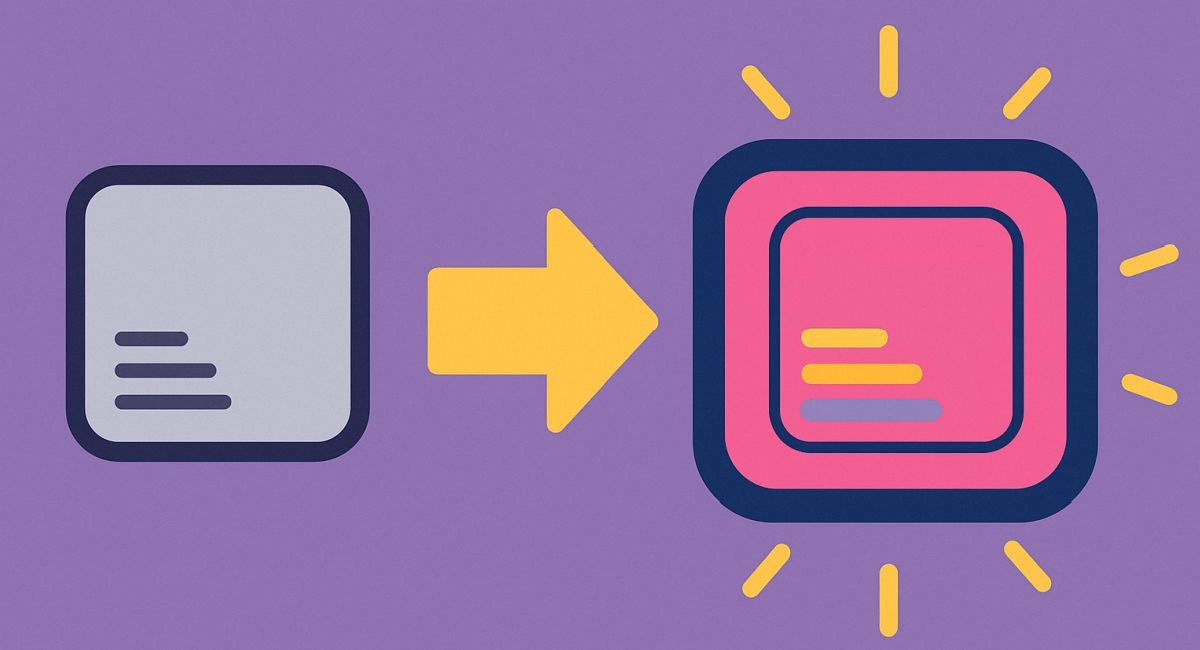
That’s your control panel in action.
Submodalities: the engine behind big NLP techniques
“Most of NLP’s best-known processes run on submodalities — the very levers, dials and buttons of your Mind’s Control Panel.
The Trauma/Phobia Cure
The Swish
Belief Change
Fast Allergy Relief
These are the processes people think are “magic” until they realise it’s just good neurology and clever mental editing.
You don’t always need the full protocols to get results.
A few tiny tweaks can change an emotional state, a belief, a pattern, or a runaway imagination.
How your brain accidentally scares you (or keeps you stuck)
Your mind doesn’t distinguish between:
A vividly imagined event, and a real one happening in front of you
So if your Mind’s Control Panel decides to broadcast a full-colour IMAX horror movie in your mind — congratulations! You get the full emotional package — but without the popcorn.
Two real clients illustrate this beautifully:
The bus driver with the invisible blockbuster
He’d been in a minor accident months earlier — He’d hit a car while driving the bus, and the car driver received a broken collarbone. No major catastrophe — but the bus driver was terrified of getting behind the wheel again.
In his head, he wasn’t replaying what happened.
He was replaying a much worse version — the worst case scenario, bigger, louder, brighter, bloodier.
A nightmare he didn’t even realise he was projecting. But so vivid it stopped him from driving the bus. Every time he sat behind the wheel, he’d have a panic attack.
He hadn’t worked for weeks.
Once we changed the imagery (small, far away, less vivid) and added a new confident driving scene, he returned to work that afternoon.
The business owner with the ‘mental block’
She knew she had to call potential new clients, or she’d go out of business. But, every time she looked at the phone, her brain served her images of people with angry faces, harsh words of rejection, embarrassment, and self-criticism — complete with running commentary. Again, a worst case scenario.
No wonder she avoided calling potential clients.
We basically reversed her submodalities. Her “mental block” dissolved because her internal film director finally stopped being dramatic — and started being realistic.
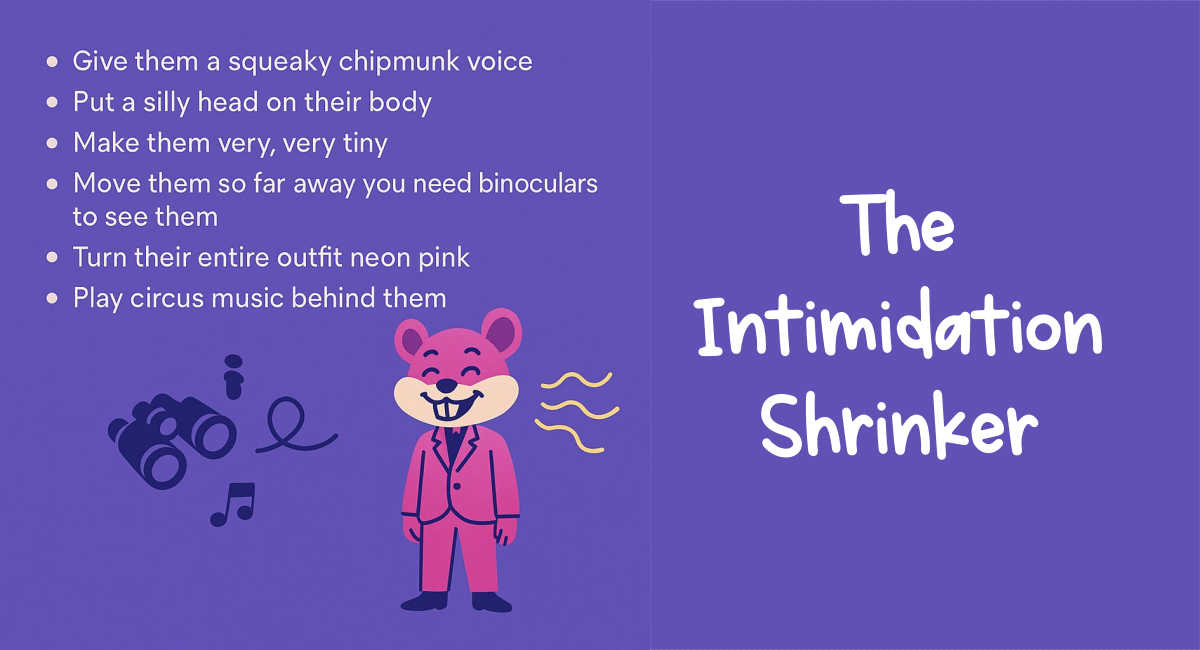
Here’s a fun one to play with — The Intimidation Shrinker
Think of someone who intimidates you (not traumatising — just mildly annoying).
Now try any of the following:
Give them a squeaky chipmunk voice
Put a silly head on their body
Make them very, very tiny
Move them so far away you need binoculars to see them
Turn their entire outfit neon pink
Play circus music behind them
Notice how quickly the intimidation evaporates.
Yes, it’s silly.
That’s the point — your Mind’s Control Panel reacts to imagery, not logic.
And now — a practical blend of ‘Twiddling your Mind’s Control Panel’ exercises
Exercise 1: The Good-Memory Upgrade
Take a happy memory. Make it:
Bigger
Brighter
Sharper
Closer
More colourful
Moving, not still
Notice what happens to the feeling.
Most people report a sudden warm rush — like switching from a 14-inch fuzzy TV (if they still make such a thing) to an 80-inch OLED.
Manifestation + Mind’s Control Panel
And here’s something people often miss: your Mind’s Control Panel doesn’t just influence memories and worries — it shapes the way you imagine your future too. When you picture a goal or desire as faint, far away, grey, or barely moving, your brain files it under “nice idea, but not today, sunshine.”
But when you brighten the image, make it closer, sharper, moving, bigger, and give it encouraging self-talk instead of doom-narration, your whole system starts treating that future as something real and attainable. It’s not magic — it’s your neurology lining up with your direction of travel. If you want more of that kind of intentional mental alignment, I’ve written about it here. How to Conquer Your Toxic Thinking to Align With Your Dream.
Exercise 2: The Worry Shrink-Down
Think of a small annoyance or nagging worry.
Now:
Make the image tiny
Push it far away
Fade the colour
Slow any sound
Turn the volume down
Add a frame around it (optional: glitter frame if you’re feeling spicy)
Your system calms.
The intensity drops.
Because you tweaked your mind’s control panel.
Exercise 3: The Internal Voice Tuner
You know that inner commentator who thinks volume equals authority?
Try this:
Turn the volume down
Slow the speed
Change the tone to something ridiculous
Give it a different accent
Play it underwater, through helium, or as if it’s wearing loose false teeth
Or move it behind you, above you, or off into the distance
Most people find the criticism loses its sting the moment the voice stops sounding credible. (One client made her inner critic sound like a malfunctioning sat-nav. She was unstoppable after that.)
Feelings are the giveaway
Most people only notice the emotion — not the settings that produced it.
But the emotion is just the output. The submodalities are the input.
Once you can see — and change — the mental coding, you have choice.
And choice is freedom.
A tiny warning label regarding your mind’s control panel
Context matters
If you brighten the image of a romantic, candlelit dinner, you get… an unromantic dinner.
If you brighten the image of a scary cellar, you get a cellar that’s suddenly not terrifying. (There’s a clue!).
Rather than trying to “think positive” try changing the structure of your experience.
If your control panel feels like it’s been tampered with… or if your mind is running settings you’d never consciously choose — SHIFT Coaching is where we sort that out. We get your internal wiring functioning properly again. Less “rogue toddler pressing buttons,” more “confident adult adjusting settings with purpose.”
If you’d like help changing the emotional coding behind the patterns that keep tripping you up, you know where to find me.